
Contemporary Spolia: Harnessing Local Flows
- Étienne Genest
- M. Arch
- Advanced architectural design (ARCH 676) and Directed research project (ARCH 683)
- Michael Jemtrud
- McGill University
- deep energy retrofits
- life-cycle assessment
- panel fabrication
Buildings are part of large networks of energy exchanges - each step in a building’s life has energy inputs and outputs. Energy is transformed, transferred, and aggregated, culminating in an assembly of artifacts at the end of materials' first “useful life” whose energy is harnessed very poorly, or not at all. Through economic globalization, the links of the networks which permit modern architecture to flourish have been scaled up at the planetary level, making them more and more lengthy and energy intensive. Very often, materials are extracted in one place in the world, are transformed into catalogable products somewhere else, and are assembled into a building on another continent altogether.
To tackle the much-needed paradigm shift toward a non-modern architecture, the research methodology of this project is based on a Life Cycle Analysis (LCA) framework. Through this lens, the boundary of the project is stretched by all the flows (i.e., energy, materials, etc.) that run through it over time. From a thermodynamic point of view, the project acts as a nexus which channels energy flows, transforms them, and dissipates them so they can be more readily be absorbed by local ecosystems. Based on a system tailored to the specificity of its host region, the project relies on short and low-energy circuits and act as an interface ensuring a close bond between the community and its architectural production; a theatricalization of the processes organizing it's built environment.
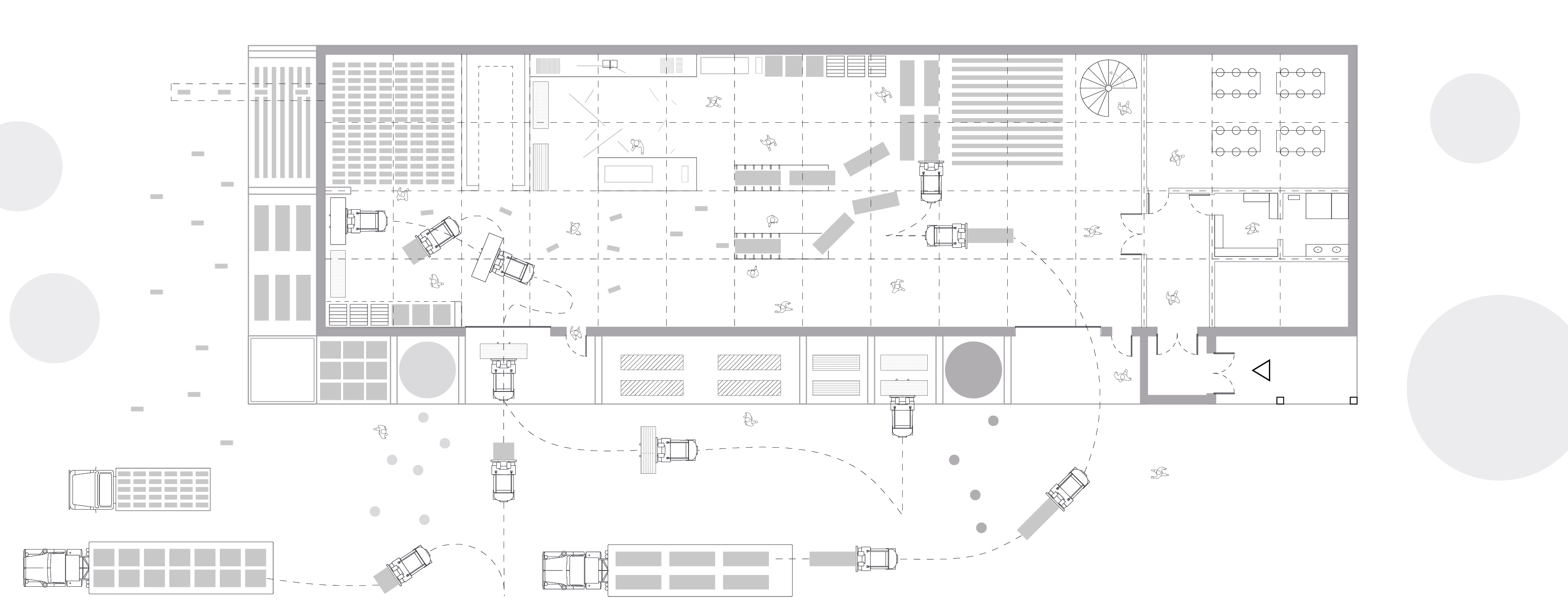
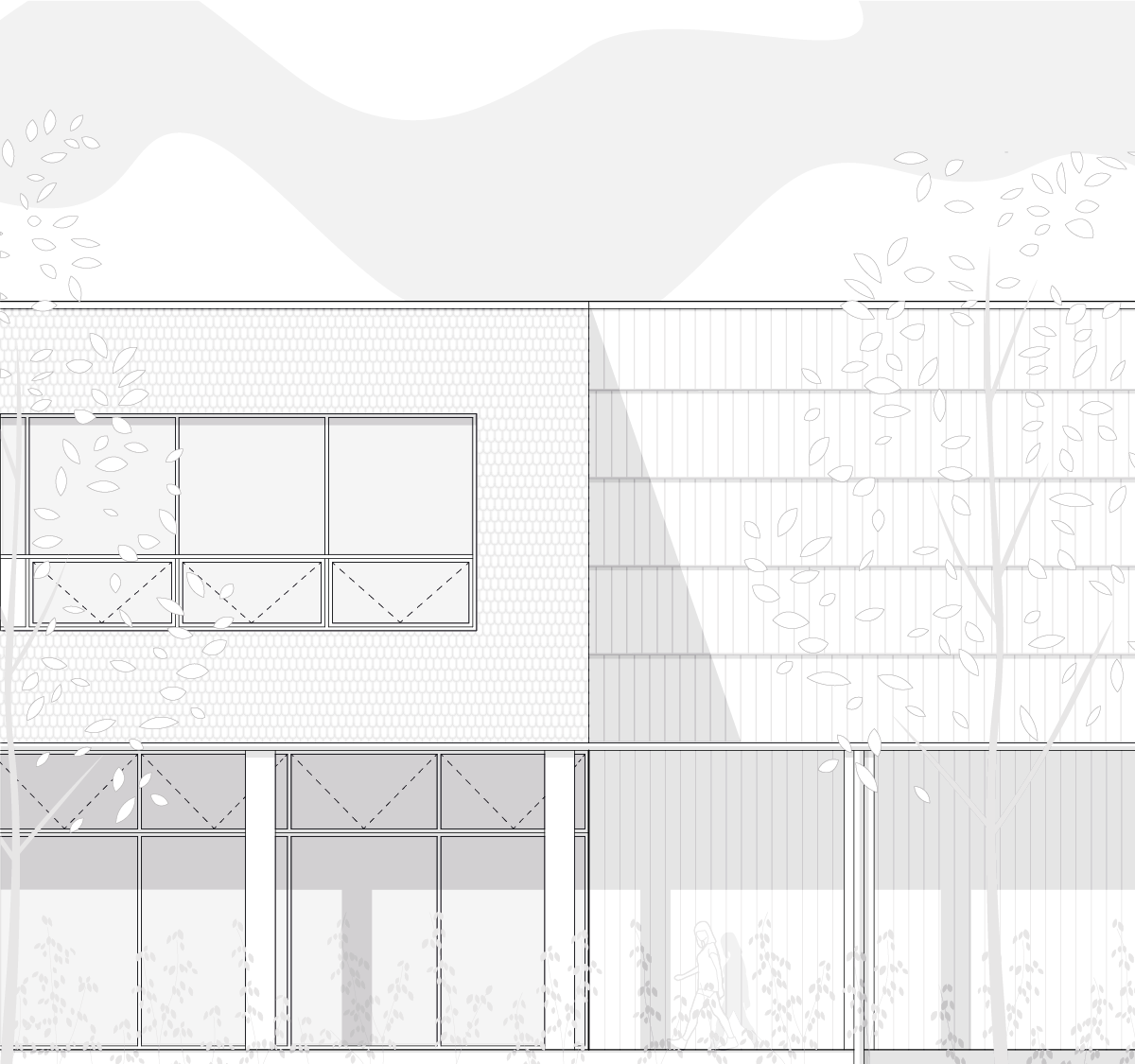
More precisely, I explore the design of a community-based factory dedicated to the production of deep energy retrofit (DER) panels. The aim is to create a hyper-local production space to study how such a typology could act as the missing link in architectural production by harnessing existing local flows and reintroducing them into the construction industry's material ecosystem. Such an endeavor could have a direct impact on the manufacturing, construction, and operational stages of a building, but, and perhaps most importantly, could also possess agency over the extraction of raw materials as well as over their end-of-life stages. This is all while DER can significantly reduce the operational emissions of target buildings, densify communities and curate new spatial experiences. Altogether, the retrofit industry could significantly grow and become leverage for systemic changes in the archaic construction industry in Quebec by pointing the way towards a more responsible contemporary architecture.


Discover Our Collaborators








- Arrondissement de l’Île-Bizard—Sainte-Geneviève
- Société d’habitation du Québec
- Building decarbonization alliance
- Pembina institute
- Québec BVI – Bâtiment vert et intelligent
- ReCover Initiative
- Retrofit Canada
- The Atmospheric Fund (TAF)
- Transition Accelerator
- Zero Emissions Innovation Centre
- If Then Architecture Inc.
- Minotair Inc.
- RG Solutions